Victor Evopa
Evolution column
Evolution series
For most of the last century, Africa's relationship with the global economy has largely been defined by what left its ports.
Crude oil left through Port Harcourt. Cocoa left through Côte d'Ivoire and Ghana. Copper left through Zambia. Gold, cotton, and coffee moved out in bulk; priced by markets thousands of miles away, paid for in currencies that were never the naira, the cedi, or the shilling.
That relationship, however, is changing.
Not because the ports have closed, but because a new export has opened somewhere the customs officers can't see it. It doesn't move through shipping containers. It moves through fiber-optic cables.
For Decades, Africa's Exports Left Through Its Ports
Africa's economic story has long been a commodities story. Oil, cocoa, gold, coffee, cotton, and minerals built entire national budgets, and entire national vulnerabilities. When global commodity prices dropped, so did government revenue. When a currency depreciates against the dollar, the cost of everything imported; machinery, medicine, fuel, rises overnight. This was an economy built on what left the continent in raw form, priced by people who never set foot on it.
That model isn't gone. Nigeria, Angola, and several other economies still depend heavily on resource exports. But it is no longer the only story, and increasingly, it isn't the fastest-growing one.
Now, Its Biggest Export Moves Through Fiber-Optic Cables
Quietly, another export has been rising alongside the old one. It doesn't travel by cargo vessel or sit in a customs warehouse. It moves through cloud servers, video calls, GitHub repositories, design files, marketing campaigns, and AI models.
Today, software is written in Lagos for startups in San Francisco. Product designers in Nairobi collaborate with companies in London. Customer success specialists in Accra support customers across multiple time zones. Content strategists in Kigali work with brands they've never met in person. Financial analysts in Johannesburg serve businesses operating thousands of kilometers away.
None of it shows up in a shipping manifest, and all of it is worth real money leaving one economy and entering another.
Call it what it actually is. Africa has both quietly and loudly begun exporting something far more scalable, renewable, and valuable in the digital age: human capability.
The Three Exports of Africa
Africa is entering a new export era; one where talent increasingly complements traditional commodities. That shift deserves far more attention than it currently receives. It deserves its own framework, one simple enough to reference again and again as this story keeps unfolding.
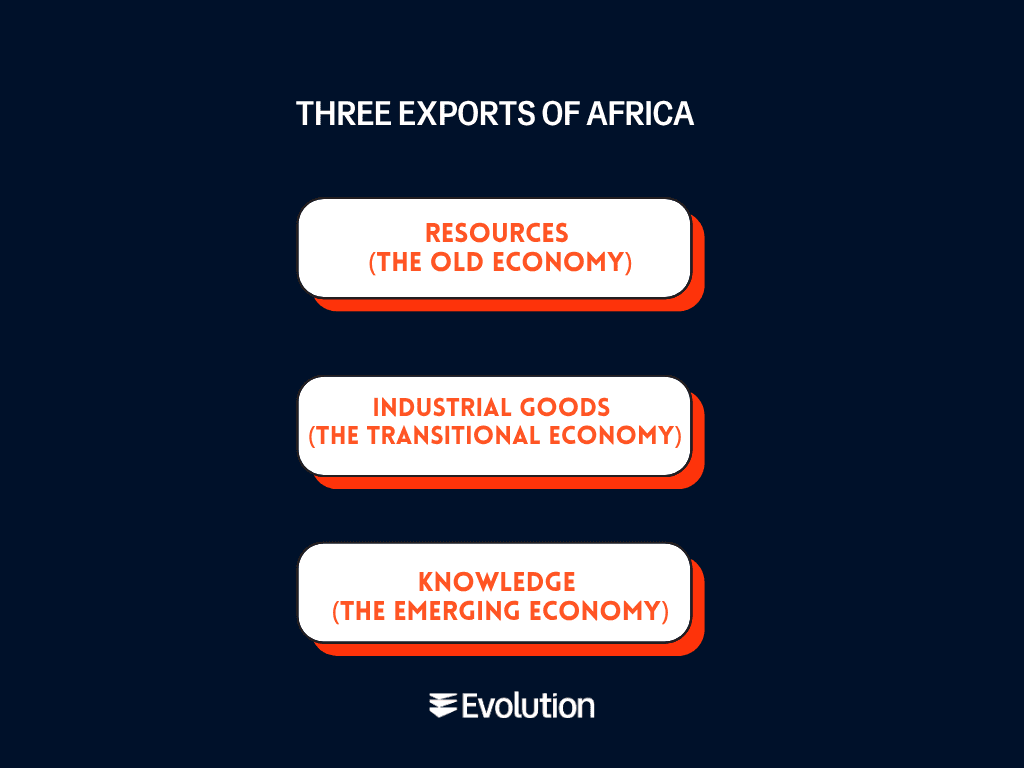
The Three Exports of Africa:
Resources (the old economy): Oil, cocoa, gold, cotton, coffee, minerals.
Industrial Goods (the transitional economy): Manufactured products, processed materials, assembled goods.
Knowledge (the emerging economy): Software, design, marketing, consulting, creative work, AI services, digital operations.
Most economic commentary about Africa still treats the continent as if it's permanently stuck in the first stage. The data says otherwise. Africa is skipping large parts of the second stage and moving directly into the third, exporting knowledge work at a pace that is starting to outrun the infrastructure built to support it.
The Statistic Everyone Quotes, But Few Fully Understand
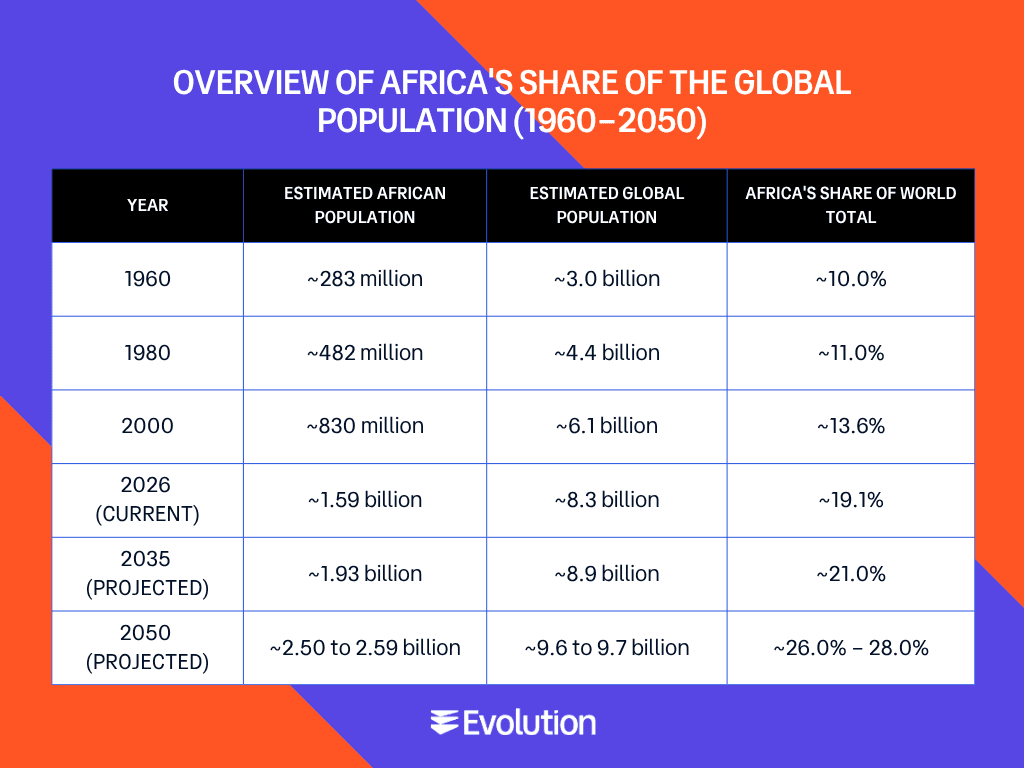
The number that gets repeated most often is the population projection: Africa is on track to grow from roughly 1.5 billion people today to about 2.5 billion by 2050, according to the United Nations Economic Commission for Africa, a jump from one in ten people on Earth in 1960 to roughly one in four by mid-century.
What gets repeated less often is the number that actually explains why this population shift matters economically. The African Development Bank estimates that between 10 and 12 million young Africans enter the workforce every year, while local economies generate only about 3 million formal jobs annually. That gap, not the population number by itself, is the real story. It is the difference between a demographic dividend and a demographic crisis, and it is precisely the pressure that is pushing millions of young Africans toward global, digital work instead of waiting for a local job market that cannot absorb them.
How the Internet Turned Talent Into a Global Export
Remote work existed before 2020 (co-vid year). What changed was permission. Companies that had spent years finding reasons not to hire outside their own city, their own country, their own continent, were forced to prove to themselves that distributed teams could function. Once that proof existed, it didn't disappear when offices reopened. It became infrastructure.
Across Africa, remote and freelance work has grown by roughly 55% since 2020, according to African Leadership Magazine, one of the fastest expansions of any region globally. In Nigeria specifically, that shift is showing up in national accounts, not just anecdotes.
The country's ICT sector contributed 11.31% to real GDP in the first quarter of 2026, up from 10.59% a year earlier, according to Vanguard's reporting on National Bureau of Statistics data, a steady climb that tracks closely with the growth in remote and digital work.
The World Economic Forum's Future of Jobs Report 2025 reinforces this trajectory. A majority of businesses in Sub-Saharan Africa identify digital transformation as one of the primary drivers of future job creation, while digital employment is projected to grow substantially over the remainder of the decade.
These are not isolated trends. Together, they point to a broader structural change: Africa is becoming one of the world's most important sources of globally connected talent.
That matters because talent behaves differently from traditional exports. Oil is finite. Minerals are depleted. Agricultural commodities depend on seasons, climate, and land. Knowledge compounds.
A software engineer becomes more valuable with experience. A designer improves with every project. A consultant accumulates expertise over time. Skills scale through learning, collaboration, and technology rather than extraction. The competitive advantage of the digital economy is no longer determined solely by natural resources. It is increasingly determined by the ability of people to solve problems across borders.
In that sense, Africa's greatest long-term resource may not lie beneath the ground. It may lie within the capabilities of its people.
Why Africa Is Already One of the World's Largest Talent Markets
There is a common misconception that Africa's emergence as a global talent hub is the result of the world suddenly recognizing the continent's potential. It makes for an inspiring narrative, but it isn't entirely accurate.
The more compelling explanation is economic.
Over the past decade, three powerful forces have converged to fundamentally reshape the global labour market. The first is the digitization of work. The second is the normalization of distributed teams. The third is the growing demand for specialized skills in an increasingly digital economy.
Together, these forces have quietly dismantled one of the oldest assumptions about employment; that talent and opportunity must exist in the same geography. In other words, Africa's opportunity is not simply that it has a large workforce. It is that an increasing proportion of that workforce can now participate in the global economy without leaving home.
One of the clearest evidence that supports this isn't a survey. It's actual developer activity. Nigeria posted 45% year-over-year growth in developer numbers on GitHub, the largest increase of any country measured that year, according to GitHub's own Octoverse research.
More recently, GitHub's 2025 Octoverse report named Egypt, Nigeria, Kenya, and Morocco specifically as countries projected to add millions of developers in the years ahead, describing a developer population that is growing and diversifying geographically at unprecedented speed.
The freelance data tells the same story from a different angle. Sub-Saharan Africa is named among the fastest-growing regions globally for freelance job postings between 2023 and 2025, and the drivers cited aren't abstract: smartphone penetration, expanding broadband access, rising technical education, and, notably, currency arbitrage, the ability to earn in dollars or euros while spending in local currency, according to industry freelance market research.
That last driver is worth pausing on, because it's an outside industry report, not Evolution Global, connecting global work directly to the need for global money.
The Financial Infrastructure Gap Nobody Talks About
There is a tendency to think that once someone has the right skills and an internet connection, the rest takes care of itself. It doesn’t.
It’s true that the internet has successfully globalized opportunity. But it has not fully globalized participation.
Consider a Nigerian freelancer who lands a client in London or Toronto. International clients may prefer to pay in US dollars, euros, or pounds sterling. The problem now is that local banking systems may not always support efficient cross-border transactions. Settlement times vary. Currency conversion introduces additional costs. Exchange-rate volatility can erode earnings before they are even spent. In many cases, professionals must navigate multiple platforms simply to receive, hold, convert, and use income they have already earned.
This is one of the defining paradoxes of the modern digital economy. Work has become global. Money, in many ways, has not.
The workaround for this problem has already started, and it shows exactly where the gap sits.
Roughly 18% of Nigerian freelancers now use cryptocurrency to receive international payment, according to Payoneer's freelancer research, one of the highest adoption rates of any country measured. Across the continent, more than a billion mobile money accounts are registered, and an estimated 45% of payments tied to cross-border independent work already move through mobile money rather than traditional banking, according to Thunes on cross-border payment in emerging markets.
Read those numbers together and the pattern is hard to miss. Millions of people are already working globally and getting paid in ways that were never designed for them, because traditional banking didn't show up in time. They built the workaround themselves, out of mobile wallets and stablecoins, because waiting for the system to catch up was never an option.
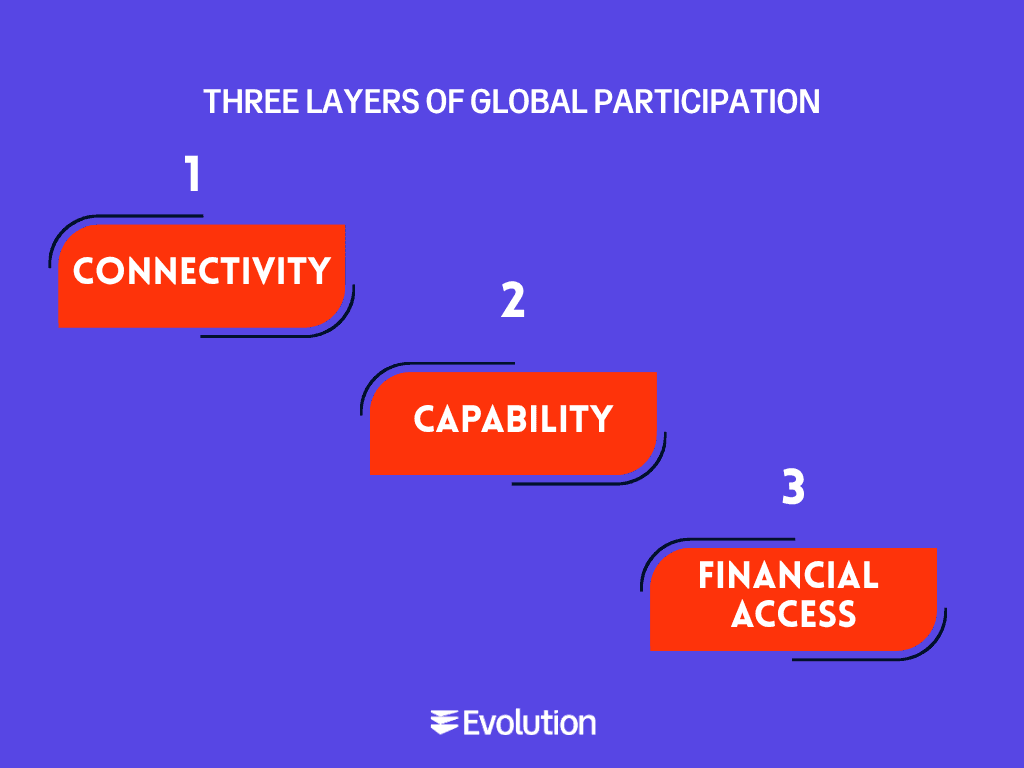
The Three Layers of Global Participation
Most conversations about Africa's talent boom stop at two layers; expanding internet access and developing digital skills. There is, in fact, a third, and it's the one that decides whether everything above it actually pays off.